

Euro NCAP (European New Car Assessment Programme) is an independent
organization widely recognized for its key role in evaluating
the safety of new vehicles in Europe. Through a series of crash tests and active safety assessments, it assigns star ratings that allow consumers to compare vehicle models based on their protection performance and driver assistance systems.

Euro NCAP test protocols are regularly updated to keep pace with technological advances and evolving mobility use cases. These updates reflect the growing integration of Advanced Driver Assistance Systems (ADAS), partial automation, driver monitoring, and post-crash safety procedures.
The objective is clear: to encourage manufacturers to go beyond regulatory requirements and deliver increasingly safer vehicles. End users especially drivers, benefit from more transparent information on the real-world performance of the systems integrated into their vehicles.
Major Changes in the Euro NCAP 2026 Protocols
The Euro NCAP 2026 roadmap represents a major strategic shift. Vehicle assessment now follows the chronology of an accident, from prevention to post-impact management. New, more demanding criteria are introduced, particularly regarding Driver Monitoring Systems, emergency response management after an accident, and the effectiveness of intelligent assistance systems.
This new approach is part of a comprehensive vision of automotive safety and lays the foundation for the Euro NCAP 2030 roadmap.
What Is a “Safety Box”?
Starting in 2026, Euro NCAP introduces a new evaluation methodology structured around four Safety Boxes, corresponding to the main stages of vehicle safety. Each Safety Box groups together a coherent set of tests and specific criteria.
Vehicle assessment now considers the entire accident lifecycle, from prevention to post-impact management. Euro NCAP specifies that this approach aligns with the principles of the Haddon Matrix, commonly used in injury prevention.
To achieve the maximum 5-star rating, a passenger car will be required, from 2028 onwards, to score at least 80% of the points in each of the four Safety Boxes, while also meeting certain mandatory prerequisites. In 2026 and 2027, Euro NCAP introduces the concept of Soft Landing, allowing manufacturers to achieve a 5-star rating through a gradual performance increase in the first two Safety Boxes.
The Four Safety Boxes Defined by Euro NCAP 2026
- Safe Driving: evaluates risk prevention related to driver behavior.
- Crash Avoidance: measures the vehicle’s ability to avoid collisions through safety ADAS (emergency braking, evasive steering assistance, obstacle detection).
- Crash Protection: assesses the ability of passive safety systems to limit injury severity for occupants in the event of a collision.
- Post-Crash Safety: focuses on accident management after impact.
Although not included in the overall scoring system, the concept of Assisted Driving in urban and highway environments is also introduced.
These technologies provide significant safety benefits while also creating new risks. Euro NCAP therefore implements a reward and penalty system based not only on avoidance performance, but also on the system’s ability to keep the driver engaged and manage failures safely.
Protocols Highlighted Within the Safety Boxes
Safe Driving
Occupant Monitoring / Driver Engagement / Vehicle Assistance
The Safe Driving Safety Box focuses on prevention and driver support. Its goal is to reduce accident risk by ensuring the driver is attentive, engaged, and properly assisted by the vehicle.
Main protocol families:
- Occupant Monitoring: presence detection, occupant classification, seatbelt usage monitoring.
- Driver Engagement: monitoring driver attention, level of involvement in driving, and ability to retake control.
- Vehicle Assistance: active driving assistance systems such as speed regulation, Adaptive Cruise Control (ACC), and Lane Keeping Assist.
Crash Avoidance
Frontal Collisions / Lane Departure Collisions / Low Speed Collisions
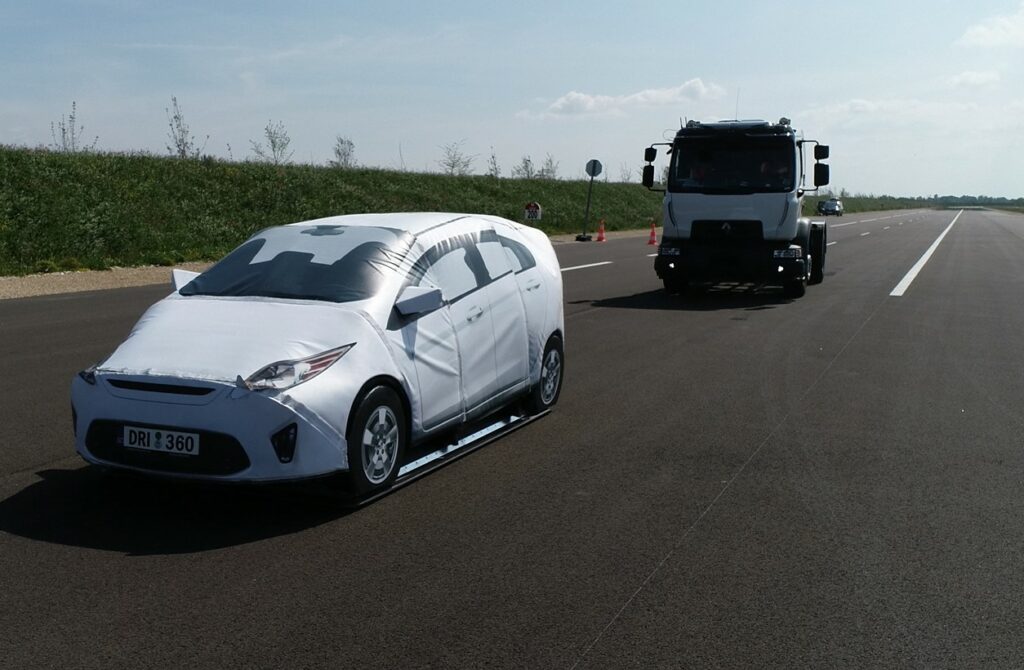
The Crash Avoidance Safety Box evaluates the vehicle’s ability to avoid or mitigate collisions through combined analysis of internal and external environments, including heavy vehicles.
Main protocol families:
- Frontal Collisions: Car-to-Car / Motorcyclist / Pedestrian / Bicyclist scenarios.
- Lane Departure Collisions: high-speed lane departures, with and without impact risk involving cars or motorcyclists.
- Low-Speed Collisions: dense traffic situations and low-speed maneuvers.
These scenarios replicate critical real-world situations such as frontal impacts, interactions with vulnerable road users, and loss of control due to lane departure.
.
Crash Protection
Frontal Impact / Side Impact / Rear Impact / Vulnerable Road User Impact
The Crash Protection Safety Box focuses on protecting occupants and road users when an accident cannot be avoided.
Main protocol families:
- Frontal Impact: tests using the latest-generation crash test dummies to provide more detailed injury analysis for drivers and passengers.
- Side Impact: reinforced tests evaluating protection in lateral collisions, including occupants seated on the far side of the impact.
- Rear Impact: advanced assessments of seats and head restraints to limit whiplash injuries.
- Vulnerable Road User Impact: new methods aimed at improving safety for pedestrians, cyclists, and other vulnerable road users.
Post-Crash Safety
Post-Crash
The Post Crash Safety Box aims to reduce accident consequences after impact, for both occupants and emergency responders.
Main protocol families:
- Rescue & Extrication: standardized rescue sheets and intervention guides for first responders.
- Post-Crash Intervention: improvements to eCall systems, multi-collision braking, and automatic activation of hazard lights.
- Extrication: electric vehicle energy management, thermal propagation prevention, and accessibility of doors and seatbelts after impact.
How Transpolis Helps Its Clients Anticipate and Succeed in Euro NCAP 2026 Tests
At Transpolis, we support manufacturers and suppliers in preparing for and validating these new requirements. From design to final validation, Transpolis positions itself as a strategic partner to anticipate Euro NCAP 2026 developments and ensure compliant, reliable, and efficient testing.
Euro NCAP also encourages manufacturers to engage with laboratories early in the development phases. In this context, Transpolis works closely with its clients to precisely define testing needs.
Why Choose Us?
Transpolis stands out for its modern infrastructure and state-of-the-art equipments, specifically designed to meet Euro NCAP and UNECE testing requirements. The center is capable of recreating a wide range of scenarios using advanced simulation tools, official VRU dummies, driving robots, and accredited test tracks.
A key strength of Transpolis lies in the repeatability of its tests, ensuring consistent and reliable results.
ISO 17025 Accredited Testing Laboratory
Transpolis is a vehicle testing laboratory specializing in the development and evaluation of driver assistance functions. It has been ISO 17025 accredited since 2022 for numerous regulations related to Euro NCAP and UNECE protocols.
In 2024, the laboratory reached a new milestone with the acquisition of ISO 17025 Flex2 accreditation, allowing regulations to be added or updated without prior assessment by COFRAC. This flexibility ensures rapid adaptation to technological and regulatory changes.
Transpolis, French State Technical Service
In 2023, Transpolis was appointed as a French State Technical Service by the National Vehicle Approval Center (CNRV). In this role, Transpolis is authorized to conduct
homologation tests and issue official test reports, in compliance with its ISO 17025 accreditation scope.